What to do to your heating before the first cold night
The first genuinely cold night of the year is when most heating faults are discovered, and it is the worst possible time to discover them.
September 17, 2026 · 4 min read
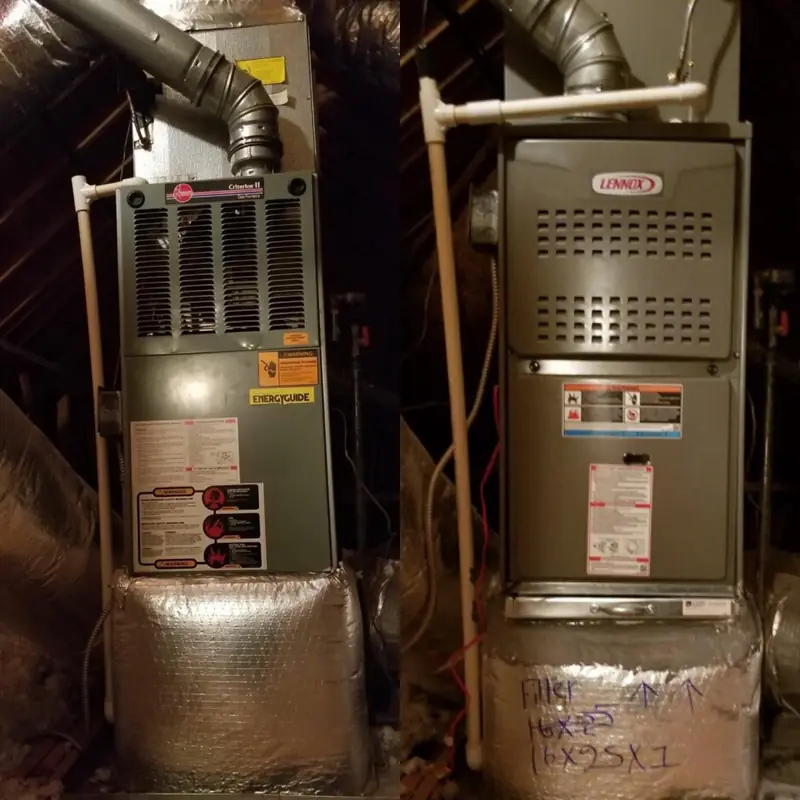
Heating systems around here sit idle for most of the year. A furnace that worked perfectly in March has then done nothing at all through spring, summer and most of autumn, and the first time anybody asks anything of it is the night the temperature drops. That is why heating call volume spikes on exactly the same evening across the whole county, and why the wait is longest precisely when you least want one.
The fix is unglamorous: test it early, while nothing depends on the answer.
Run it before you need it
Pick a mild day, switch the system to heat, and set the thermostat several degrees above room temperature. Then stay with it for a quarter of an hour or so and pay attention.
A burning smell on the first run is normal and is dust burning off the heat exchanger. It should fade within a few minutes. What is not normal is a smell that persists, a burning smell that is sharp or electrical, or any smell of gas at all. If you smell gas, leave the house and call your gas utility before you call anyone else.
- Confirm warm air actually reaches every room, not just the ones nearest the unit
- Listen for grinding, squealing or repeated clicking without ignition
- Watch whether it starts, runs briefly and shuts off again
- Check the flame is steady and blue rather than yellow and lazy, if you can see it safely
- Notice whether the system reaches the setpoint or just keeps running
A system that starts, runs for a short while and then shuts down before reaching temperature is the pattern worth taking most seriously. Short cycling on heat often points at restricted airflow, and restricted airflow lets the heat exchanger get hotter than it should. It is a fault that tends to get worse rather than settle.
The things you can do yourself
- Fit a fresh filter before the season starts rather than midway through it
- Clear leaves, mulch and summer growth away from the outdoor unit if you have a heat pump
- Make sure supply and return vents are not blocked by furniture moved over the summer
- Replace thermostat batteries if yours takes them
- Clear anything stored against the furnace, particularly anything flammable
The last one matters more than it sounds. Furnaces live in garages, closets and attics, which are exactly the spaces that accumulate stored belongings over a summer. Combustion appliances need clearance around them, and paint tins and cardboard should not be part of the arrangement.
The checks that need a technician
Some of an annual heating service is genuinely not a homeowner job, and not because of trade protectiveness. Inspecting a heat exchanger for cracks, testing a flue draft, checking gas pressure, and measuring the amp draw on a blower motor all need instruments and the training to interpret what they say.
A cracked heat exchanger is the reason this list exists. It is not something you can reliably see or smell, and it is the fault with the most serious consequences, because it can allow combustion gases into the air the house is circulating. It is checked with instruments and experience, and it is checked before the season rather than during it.
Our technicians are NATE certified, which is the trade's own competence standard, and we work on all makes and models: Lennox, American Standard, Amana, Bryant, Carrier, Heil, Goodman, Rheem, Ruud, Trane and York.
Heat pumps are worth a separate mention, because a good number of houses around here have one and the winter behavior confuses people. A heat pump in heating mode delivers air that is warm but not hot, noticeably cooler than a gas furnace delivers, and that is normal rather than a fault. It will also run a defrost cycle periodically in cold damp weather, which means the outdoor unit steams, the indoor air briefly cools, and everything then returns to normal. Neither of those is a reason to call. Air that is genuinely cold, or a unit iced over and staying iced, is.
If it is already too late for early
If you are reading this on the cold night rather than before it, the useful thing you can do is be specific when you call. What is it doing, what did it do just before it stopped, is there any noise, is there any smell, and does it start at all. That description does real work. It tells us what is likely wrong before we arrive, and it decides what comes off the van.
We are open 8:00 AM to 8:00 PM Monday to Friday and 9:00 AM to 3:00 PM on Saturday, and we cover Rockdale, Newton, Henry and Dekalb Counties. Comfort Club members go to the top of the repair queue, which on that particular evening is worth having.
Comfort Central Cooling & Heating, (678) 726-6333
Call (678) 726-6333More articles
Five things worth settling before you replace an HVAC system
A replacement is a fifteen year decision made in about two days. These are the parts of it people most often wish they had asked about.
Cutting a Georgia summer power bill without buying anything
Before you spend money on efficiency, there is a list of free changes that most houses here have never had done.